
Ask Chappell Square
Frequently Asked Questions & Answers
Answers to some of the most frequent Chappell Square questions customers ask.
Can’t find the answers to your question below? Send us an email.
The Chappell Universal Square is proudly Made in the USA.
Why is the Chappell Square called the Universal Square?
Chappell Square is called the Universal Square because of two core features that form its patented system. The first is a set of powerful, comprehensive rafter tables deeply etched into the legs of the square. The tables are designed for universal application, allowing them to be used seamlessly across any measurement system—whether it be metric, imperial, cubits, or even the Japanese system of Shakkanh.
The second feature is its base-10 hybrid imperial-decimal ruling system, which merges traditional fractional-inch markings with decimal-inch graduations into a single, unified scale. This integration enables fast, intuitive interpretation and eliminates the need for constant conversion between formats.
Together, these two integrated features create the Patented Chappell Universal Square System—allowing the data in the tables to be applied consistently and efficiently across any decimal-based measurement system.
The Chappell Universal Square is also built to work with any subdivision of measurement—across any measuring system. Whether you’re using fingers, palms, or cubits; inches, feet, or yards; millimeters, centimeters, or meters—or even traditional Japanese units like bu, sun, and shaku—the result is the same. Fast, accurate answers delivered directly in your chosen system. No conversions—No guesswork—No limitations.
This adaptability is what defines the Chappell Universal Square. It’s more than a square—it’s a powerful, cross-platform instrument, engineered for speed, accuracy, and total versatility.
Chappell Universal Square — tuned to the key of success.
How long will it take to ship my square once I’ve placed my order?
Orders typically ship within 7–10 days. Each square is hand-finished, inspected and prepped for shipping on an order-by-order basis. Once shipped, delivery time depends on your chosen shipping method and location. This can add 3 to 7 days. All orders are shipped in the same order they are received. We recommend choosing USPS Priority or USPS Ground Advantage.
What type of guarantee does Chappell Square provide?
We offer a 90 day 100% satisfaction guarantee. If the Chappell Square does meet your expectations for any reason, send it back for a complete refund. No questions asked! We’ll even pay the postage.
Why does the Chappell Square use minor rulings of .05″ instead of fractional 1/16 (.0625)?
Metric & Imperial Inch Ruling
Chappell Universal Square produces a line of Metric and Imperial precision-ruled instruments for woodworkers and machinists. Metric is a base-10 decimal system with minor divisions that universally come in two flavors—millimeters and centimeters. The imperial system uses the inch and foot as standards, but the possible divisions within the inch are virtually infinite. In practice, the common divisions use 1/64, 1/32, 1/16, 1/8 and 1/4.
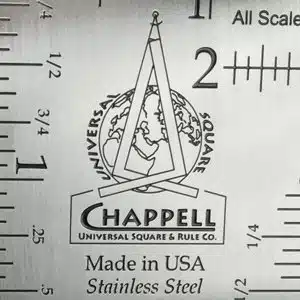
The 1824 Master Framer and 1218 Traveler framing squares are imperial inch ruled, with major divisions of 1/4 inch (.25). The Chappell Square divides the 1/4″ division with 5 rule marks of .05″ each, instead of 4 rule marks of 1/16″ (.0625). Thereby, the fractional imperial inch is seamlessly transformed into a universal imperial-base-10–decimal inch system.
Hybrid Inch Ruling
This Hybrid Inch Ruling system allows all calculations, just like in metric, to be as simple as counting money, and the data in the rafter tables can be applied directly to the square. At once, eliminating frustrating fractional conversions. This alone results in fewer errors, reduces mental fatigue and speeds up workflow.
Conventional framing squares, use a mix of 8ths, 10ths, 12ths, and 16ths. An inconsistent system that often leads to confusion and mistakes. The Chappell hybrid ruling system eliminates this issue entirely. Fractional systems remain useful for intuitive and visual divisions—like dividing up produce at your local coop. But they become awkward and inefficient when greater precision and math calculations are required. Refining accuracy means stepping through increasingly small fractions (32nds, 64ths, 128ths, etc.). In contrast, a decimal system simply extends by place value. This makes decimals better suited to modern tools and calculations, and why the metric system is the most common system in use worldwide.
Chappell Hybrid Imperial/Decimal Ruling
The beauty of the Chappell Universal hybrid ruling isn’t that it replaces fractions—but that it seamlessly merges the imperial fractional and decimal inch into one fluent system. The Chappell Hybrid Ruling is an imperial fractional inch scale, aligned with common fractional points— ¼, ½, and ¾. Fractional quarters match the decimal equivalent as .25, .5 and .75—preserving the fractional format of the imperial inch without confusion. Most people naturally understand and can equate that 1/4″ equals .25″, 1/2 equals .5, etc. The Chappell Hybrid Ruling preserves the familiar imperial fractional scale and brings it into the 21st Century, by merging fractions seamlessly into a base-10 decimal system. This results in improved consistency and precision.
Addendum to the Facts
Carpenters are an intuitive bunch! Over the ages they’ve come to own and master the territory that lies between the 1/4 inch marks on the imperial scale. The odds are that any carpenter worth their salt can pinpoint a mark in this realm to within 1/100″ by mere intuitive feel. Even with no minor rule divisions to guide them beyond the 1/4 goal posts, I’d keep my money on the table.
A complete vernacular vocabulary has even evolved to define this less-than-1/4″ territory. Even those who have dabbled in carpentry in only a casual way are likely familiar with this vocabulary in some measure. Those who may be confused with the Chappell Ruling having five rule-marks dividing the 1/4 inch, instead of four, need not fear. Just imagine using each rule mark as if it were a 1/16. This will result in a margin of error well within what even perfectionist may normally be accustomed too. Perhaps even, a wee bit more accurate.
A ‘wee bit’ More or Less…
Carpenters and builders commonly add or subtract a ‘wee bit‘ to measurements to allow for compression or slop. Let’s face it, rarely is a measurement EXACTLY on the tic line, so carpenters are always dealing with pluses and minuses—working within the realm of the rule lines. And while the precise value of a ‘we bit‘ is not a fixed measure, any carpenter with even a tad of experience understands precisely what it means. It turns out that the ‘wee bit’ carpenters use as a measuring unit is precisely the difference between 1/16 (.0625) and the Chappell ruling of .05. The difference, or wee bit, being .0125″. This happens to align perfectly with the terms, ‘a tad’, ‘a knife blade’, or ‘a hair‘. How about that for serendipity? There just may be rhyme to reason after all!
Bottom line, the Chappell Hybrid Imperial-Decimal Inch Ruling will become second nature in just the blink-of-an-eye. Making you a more efficient carpenter and builder. In a trade that increasingly intersects with digital tools, a unified, calculator-friendly, decimal measurement system offers a clear advantage.
To learn more about the Chappell Ruling, check out our YouTube Channel
How accurate are the Chappell Squares?
The Chappell Universal 1824 Master Framer: guaranteed to be square within .003″ over the length of the 18″ tongue. This equates to .00015 per inch, which is well within the tolerances of Grade A, High-Precision Toolmaking Standards. The Chappell Center Rule Bench Squares have an even higher accuracy suitable for use as a Machinist Square. Their tolerances are well within the machinists and engineering standards of .0001″ per inch. This makes the Chappell Squares one of the most precise Framing Squares and Bench Squares on the market.
Why do many squares sell for much less than Chappell Universal Squares?
Chappell Universal Square’s intent at the outset was to produce all of our squares and products in the USA. We quickly discovered that the easiest path led to China. In the end, and against some tough challenges, we committed to making the Chappell Square 100% Made in the USA. Made in USA required more time and a greater investment, and a willingness to think outside the box. In many ways, we had to build the process from the ground up. Our final choice was to compete with quality over quantity. To provide products that had true value that would last for generations.
Deeply Photo Etched Stainless Steel Squares to last a lifetime.
Chappell Squares are etched using a Photochemical Etching Process. This process allows for the super fine detail and deep etchings found on our squares. The quality is evident in every square we produce, and one of the reasons Chappell Universal Squares stand apart from all others.
In addition, Chappell Squares are CNC milled as a final step to ensure the highest tolerances of squareness and edge quality. The center-rule bench squares meet the standards required for machinists and engineering squares. This absolutely adds to the production cost, but we believe it adds VALUE that will last for generations.
Proudly made in the USA.
Chappell Universal Square is committed to using only American-made stainless steel. This increases production complexity and cost. These choices were not the most economical—but were deliberate. Chappell Square products are made to provide quality and value that will endure far beyond the memory of its purchase price. And something that will last for generations. Chappell Universal Square believes that supporting American builders and manufacturing matters.
Please contact us if you have any questions. We would be happy to answer them for you.
Chappell Universal Square—Rebuilding America One Square at a Time.
Join the Revolution!
Visit the Chappell Square YOUTUBE Channel
Learn just how easy it is to use the Chappell Universal Square by viewing our informative series of instructional videos.
Learn more about: UNEQUAL PITCHED RAFTER TABLES
And while you are at it, check out: THE POLYGON RAFTER TABLES